
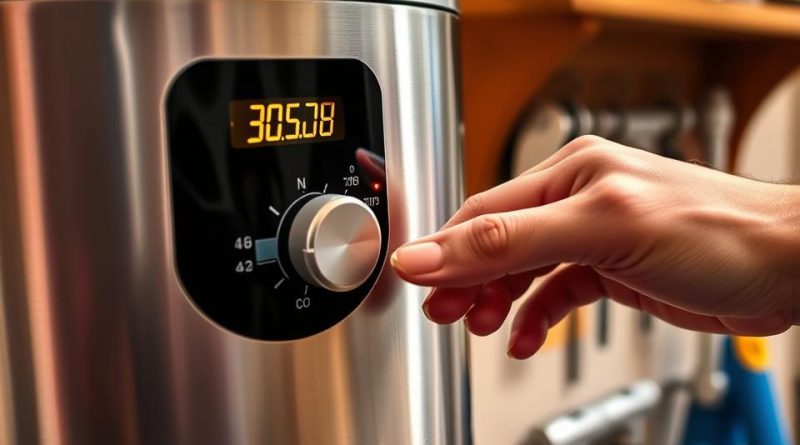
Adjusting your water heater’s temperature is important for comfort and safety. Wrong settings can cause scalding or too cold water. Also, setting the right temperature saves energy and cuts down on your electricity bills. Knowing how to lower your water heater’s temperature is key to a perfect home setting.
The Consumer Product Safety Commission (CPSC) suggests keeping your water heater at 120 degrees Fahrenheit to avoid burns. This is especially crucial for families with young kids and older adults. On the other hand, OSHA recommends a minimum of 140 degrees Fahrenheit to prevent Legionella bacteria. So, it’s best to maintain your water heater between 120 and 140 degrees Fahrenheit for both safety and efficiency.
Setting your water heater to the right temperature is very important. At 140 degrees Fahrenheit, the risk of getting severely burnt is high. Both adults and children can get third-degree burns in just five seconds. For safety, it’s smart to keep your water heater set lower. The U.S. Department of Energy and OSHA both suggest 120 degrees is safer for most homes.
Keeping the right temperature on your water heater makes it safer, especially for kids and older people. They can get burned easier because their skin is thinner. Also, keeping the temperature under 120 degrees stops hard water buildup. This can help your water heater last longer, usually 8 to 12 years.
Lowering your water heater temperature can also save you money. By setting it lower, you could use up to 22% less energy. This could save up to $61 every year by reducing the heat that’s lost when not in use. Also, tankless water heaters are even more efficient because they only heat water when needed.
| Water Temperature Setting | Scald Risk | Utility Savings | Maintenance Impact |
|---|---|---|---|
| 140 degrees Fahrenheit | High – Risk of third-degree burns | High annual standby heat loss cost | Accelerates sediment buildup |
| 120 degrees Fahrenheit | Low – Reduced scald risk | Up to 22% energy savings | Minimizes sediment buildup |
It’s important to find the best temperature for your water heater to keep your home safe and efficient. The Occupational Safety & Health Administration (OSHA) recommends a setting of at least 140 degrees Fahrenheit. On the other hand, the Consumer Product Safety Commission (CPSC) suggests not going above 120 degrees Fahrenheit. This range helps stop bacterial growth and lowers the risk of burns, especially for kids and seniors.
Setting your water heater’s temperature right can help you save on energy bills. Lowering the heat by 10 degrees from 140°F can cut energy use by 3-5%. Since heating water makes up 14-18% of a home’s energy bill, this small change can have a big impact.
It’s a good idea to check your water heater’s settings regularly, especially when the seasons change. Modern tankless water heaters with digital thermostats make it easy to keep the temperature just right.
In conclusion, setting your water heater to the suggested temperatures is key for safety and saving energy. Knowing how to set temperature on hot water heater correctly lets us enjoy these benefits fully.
Adjusting your water heater is crucial for safety and efficiency. Make sure to turn off the power first. This step prevents any electrical accidents while adjusting temperatures.
To adjust the temperature, find your water heater’s thermostat. It’s usually behind an insulated panel. For electric models, you might have to change both thermostats for it to work right.
The Consumer Product Safety Commission (CPSC) says to keep heaters under 120 degrees Fahrenheit to avoid burns. But OSHA says to set them at least 140 degrees Fahrenheit to stop Legionella bacteria from growing. The best range is between 120 to 140 degrees Fahrenheit for both safety and energy savings. Yet, setting it at 140 degrees can cost you an extra $36 to $61 yearly due to heat loss.
After changing settings, check the water’s temperature. Do this three hours later to make sure it’s right. This is key to avoid burns and ensure your heater works as needed.
Setting the heater to 120 degrees Fahrenheit can save 3-5% in energy costs for every 10°F drop. Since heating water makes up 18% of your home’s energy use, changing it can lower your bills. But having it at 140 degrees increases the risk of severe burns quickly and can harm your pipes and appliances over time.
It’s smart to check your heater’s temperature every six months. This helps keep it safe and efficient, extending its life and saving you money and trouble.
Adjusting your electric water heater’s temperature can help save energy and keep your family safe. Let’s go over how to properly adjust your water heater. This will make sure it works well and reaches the temperature you want.
First, make sure to turn off your water heater’s power. This is important for safety to avoid any electrical issues. Find your circuit breaker panel and turn off the switch for your water heater.
After turning off the power, take off the water heater’s access panels. You’ll need a screwdriver as they’re held on by 2-4 screws. Inside, you’ll see the upper and lower thermostats.
Then, with a flathead screwdriver, tweak the thermostat settings. It’s key to set both the upper and lower thermostats to the same degree. Aim for a temperature between 120°F and 140°F. Setting it at 120°F is recommended for safety and to save energy.
The default setting is usually 140°F, which can be too hot for kids and the elderly. Lowering it to 120°F helps prevent burns and cuts energy costs. Heating water makes up about 18% of your home’s energy use.
Once you’ve adjusted the temperatures, reattach the access panels with screws. Then, turn the power back on at the circuit breaker.
Wait a bit for the water to heat up to the new setting, then check the temperature at a faucet. If the hot water isn’t consistent, you might need a new thermostat.
Knowing how to adjust the temperature of your electric water heater can lower your bills and enhance safety. Doing this adjustment correctly ensures your family is both safe and comfortable.
Changing the temperature of your gas water heater is key for coziness and saving energy. Most models have a dial for easy temperature changes. You won’t need tools to adjust it, which makes the process simple.
First, make sure to turn off the gas to stay safe. Find the temperature dial at the unit’s bottom. Turn it to your preferred temperature. A good range is 115 to 120 degrees Fahrenheit. Yet, some heaters let you increase the temperature by about 10 degrees with settings A, B, and C.
After adjusting, you might have to re-light the pilot light. Just follow what the maker’s guide says to do this. Then, check if the system works right. It’s smart to check the water’s heat before and three hours after changing it. This ensures the adjustment worked.
Lowering your water heater’s temperature even by a little can cut energy costs by 5%. Amazingly, 42% of people set their heaters too hot. This leads to wasted energy and higher bills. Using a vacation mode also cuts down heating needs, saving more energy and money when you’re not home.
A detailed table below shows how changing gas water heater temperatures affects different things
| Temperature Setting | Impact | Safety Note |
|---|---|---|
| 115-120°F | Best for saving energy and being comfortable | Keeps the risk of burns low, as the CPSC suggests |
| 130-140°F | Hotter temperatures for special needs | OSHA suggests 140°F to stop Legionella bacteria |
| 150°F+ | Can cause burns; best to avoid | Getting a third-degree burn can take just two seconds at 150°F |
Lowering your gas water heater’s temperature can really help save on energy. This is good for both your pocket and the planet. Make sure to follow safety rules and the maker’s guide when you adjust it to avoid any risks.
Setting the right temperature on a tankless water heater is key for safety and efficiency. You should aim for about 120°F (49°C), even though many come set at 140°F (60°C). Changing these settings can make your home more comfortable and safe. It also affects how much energy you use and your bills.
To change the temperature, use the digital control panel that comes with most models. Always follow the maker’s guide to make adjustments safely and correctly. Think about your home’s needs, like how many people are there and how far water needs to travel, to get the temperature just right.
Here’s a list of ideal temperature settings for different home tasks:
Using your water heater at 120°F (49°C) can help avoid burns. This is especially important for kids and the elderly. It can also save on energy, cut down your bills, and make your heater last longer by reducing damage. Plus, lower temperatures lessen the chance of mineral deposits that can hurt the heater over time.
By correctly setting your water heater controls and checking the temperature regularly, you make sure it works well for your home. Remember, tankless water heaters give hot water instantly without wasting energy, which saves you money.
Adjusting your water heater can lead to several problems. These can affect how well it works and your comfort.
One big problem is uneven heating. Sometimes, parts of the water stay cool after you adjust the temperature. This might mean there’s sediment buildup or a broken heating element. It’s important to clean out your heater every year. This helps avoid problems from minerals in the water, especially in places with hard water like Calgary.
Another issue is not getting water hot enough. Often, this is because the thermostat doesn’t work right and needs to be replaced. Studies show that bad thermostats or heating elements impact up to 20% of water heaters.
Also, mineral limescale can block water flow and lower heating efficiency. This problem hits about 75% of homes with hard water. Older homes without thermal expansion tanks may also leak. This happens because of too much pressure inside.
To avoid these issues, we should quickly look into any water heater temperature problems. By keeping up with maintenance, like regular cleanings and checking parts, we can prevent many of these issues.
| Issue | Cause | Prevalence |
|---|---|---|
| Mineral Buildup | Hard water with high calcium and magnesium | 30% in Calgary |
| Thermostat Failures | Aging components | 15-20% of units |
| Water Leaks | Aging, poor installation, or maintenance | 15% of heaters |
| Foul Odors | Bacterial growth | Up to 10% of heaters |
| Temperature Variations | Sediment buildup, faulty elements | 75% of homes with hard water |
Adjusting your water heater’s temperature is not just about saving energy. It also brings many other great benefits. One key advantage is reducing the risk of getting burned. This is very important in homes with small children. By setting your heater to 120ºF, you lower the chance of accidental burns.
There’s also a great reason to turn down the water heater temperature to save money. Water heaters are usually set at 140ºF. But setting them to 120ºF is good for most families. Doing this can cut your energy costs by 4% to 22% every year. For instance, in places like Massachusetts and New England, where the monthly utility bill averages $116.97, you could save about $12 each month.
Lowering the water heater temperature helps your appliance last longer too. It does this by reducing mineral buildup and corrosion. Because high temperatures can make these problems worse, they can lead to frequent and expensive repairs.
Moreover, a cooler water temperature helps with household tasks. For example, dishwashers and washing machines work well without needing very hot water. This small change can lead to big savings and better safety. It makes your home more energy-efficient.
| Temperature Settings | Benefits |
|---|---|
| 120ºF | Reduced scalding risk, energy efficiency, longer appliance lifespan |
| 130-140ºF | Potential higher cleaning efficiency but increased scalding risk |
In summary, the perks of setting your water heater to a lower temperature include saving money and improving safety. It’s a wise and useful choice for any home.
Setting your water heater right is key for safety, saving energy, and cutting costs. Here’s professional advice on managing your water heating system well.
First off, always check your water heater’s temperature. The U.S. Department of Energy suggests 120°F (49°C) for best efficiency and safety. This helps lower heat loss, which is great if your home has older, thin insulation.
Temperatures over 140°F could burn you. Shower water shouldn’t get hotter than 115°F to avoid burns, say plumbing rules. For homes with older folks or those with weak immune systems, adding devices to prevent scalding is wise. This keeps everyone safe, even when you need hotter water to stop bacteria like Legionella.
Keeping your water heater in good shape is vital. Sediment buildup can mess with water temperature and flow. So, flushing the tank now and then is a must. If water temperature is all over the place, you might have pipe mix-ups or bad thermostats. You might need a pro to check and fix it.
If you’re leaving for a while, lower your water heater’s setting. The vacation mode, about 50°F, saves energy when you’re not home. Wrapping your water heater and pipes can keep heat in, using less energy.
Here’s a quick guide to setting your water heater:
| Feature | Optimal Setting | Comments |
|---|---|---|
| Standard Temperature | 120°F (49°C) | Recommended by the U.S. Department of Energy for safety and efficiency. |
| Shower Temperature | 115°F max | Prevents scalding injuries. |
| Vacation Setting | 50°F | Saves energy during extended absences. |
| Anti-Scald Devices | Mandatory for >140°F | Necessary for safety at higher temperatures. |
| Maintenance | Regularly | Essential for preventing sediment buildup and maintaining performance. |
| Insulation | Tank and Pipes | Reduces heat loss and enhances efficiency. |
By using these tips, your home will have safe, efficient, and cost-friendly hot water all year.
To ensure your water heater lasts long and works well, it’s key to use the right maintenance guides. Start with the manual that came with your heater. It has tips just for your model. Keeping up with this info will help you avoid future problems.
Getting help from professional plumbers is also smart. They do checks that typically cost between $80 and $150. But they’re worth it because they can save you money on energy. By insulating your heater and pipes, you might save 4% to 9% on heating water. Also, getting it checked every year helps find small problems before they turn into big, expensive ones.
Groups like ENERGY STAR give great advice on saving energy with your water heater. Doing things like flushing the tank each year can make your heater last longer. This can also cut your heating bills by 5% to 10%. Turning down the thermostat by 10 degrees can save you 3% to 5% every year. Following these tips will make your water heating system work better and last longer.